
Non-fatal strangulation review

Review update - Final report live
On 30 September 2025, we delivered our final report and recommendations to the Attorney-General. On 11 February 2026, the report was made public following the Attorney-General tabling it in parliament. To enhance understanding of our recommendations, we also published Kim’s story. Kim is a fictional victim-survivor of strangulation. We share Kim’s story to show some problems with the current non-fatal strangulation offence and how our recommended reforms would lead to fairer outcomes in Queensland.
The report reflects our research and legal analysis. It also reflects the findings of our extensive engagement with stakeholders across the justice sector and community.
The Commission make 18 recommendations for change. We recommend:
- Educating the public and professionals (including health and justice professionals) about the risks and dangers of strangulation
- Enhancing the non-fatal strangulation offence in s 315A by:
- better reflecting the seriousness of the conduct
- expanding the types of relationships to which the offence applies
- clarifying the defences that should and should not apply
- addressing the challenges with proving restriction of a person’s respiration and/or blood circulation
- modifying the way consent is relevant
- Improving the investigation, charging, prosecution and sentencing of non-fatal strangulation
- Improving the experiences of victim-survivors in the justice system
- Building a better evidence-base about non-fatal strangulation and the impact of any reforms
Our review
On 5 September 2024 the Queensland Government asked us to examine and make recommendations about the offence of non-fatal strangulation in a domestic setting in section 315A of the Criminal Code, and applicable procedural rules and practices.
We were asked to recommend whether:
- the terms ‘chokes’, ‘suffocates’ and ‘strangles’ should be defined and, if so, in what way
- the requirement that the choking, suffocation or strangulation must occur ‘without the other person’s consent’ should be removed or amended
- the offence should apply to conduct that is not committed between those in a domestic relationship, or is not ‘associated domestic violence’ under the Domestic and Family Violence Protection Act 2012
- the current maximum penalty of 7 years imprisonment reflects the gravity of the conduct
- the offence should be able to be finalised in the Magistrates Court.
Terms of reference
The terms of reference from the Attorney-General are available to download.
Project timeline
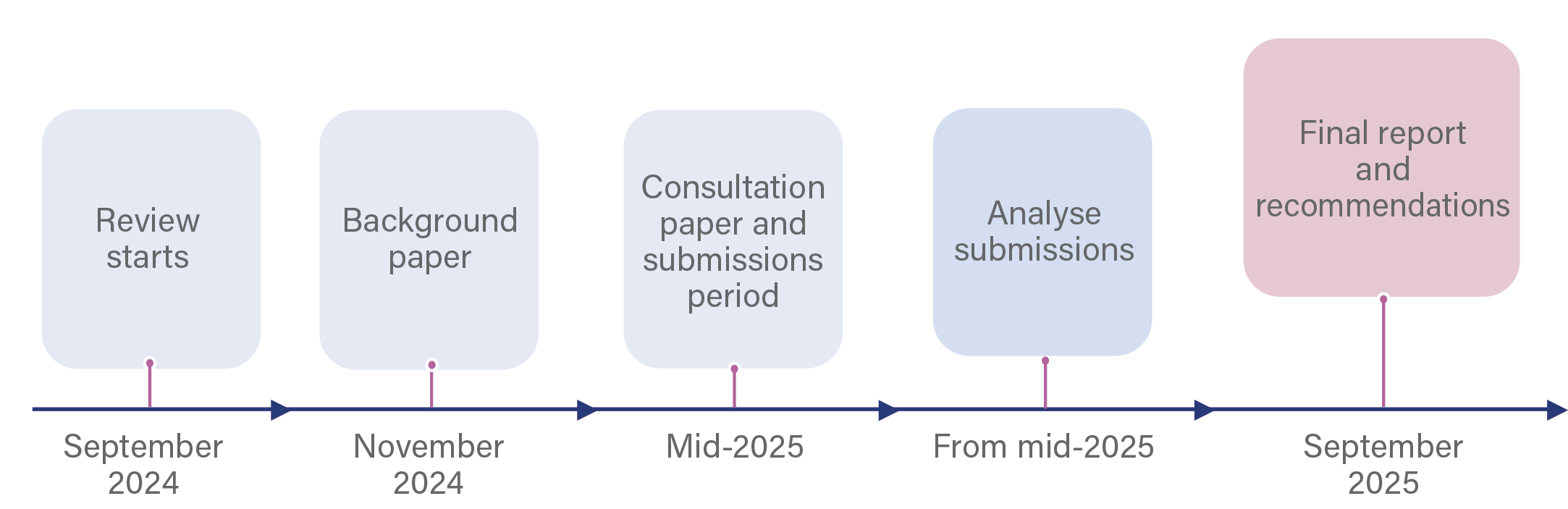
The review started on 5 September 2024.
On 11 April 2025, we released our consultation paper. It included questions for consultation and asked for submissions.
Our final report and recommendations were delivered to the Attorney-General on 30 September 2025.